1. Find the full number, then match the set
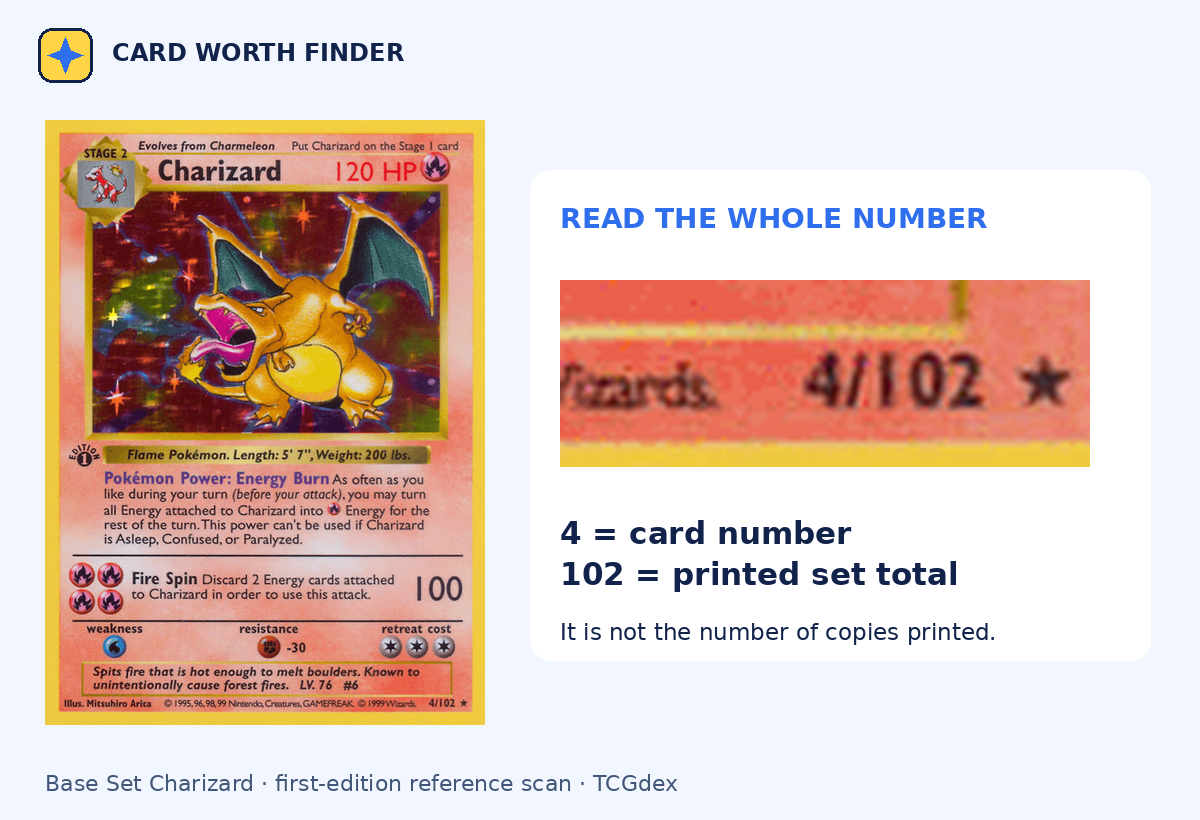
Look along the bottom edge for the collector number. Write down the whole number, including a slash or letter prefix. In 4/102, 4 identifies the card within that numbered set; 102 is the printed set total. It does not mean only 102 copies exist.
Find the set symbol or code as well. Its position varies with the card layout. English Scarlet & Violet cards introduced letter-based expansion codes at the lower left. The rarity mark is a different clue: do not confuse a rarity star with the set identifier.
Original English Base Set has no expansion symbol, but a missing symbol on its own does not establish Base Set or authenticity. Match the full design and numbering. Use the set-identification guide if the set is still unclear.
2. For English Base Set Pokémon, compare stamp and frame
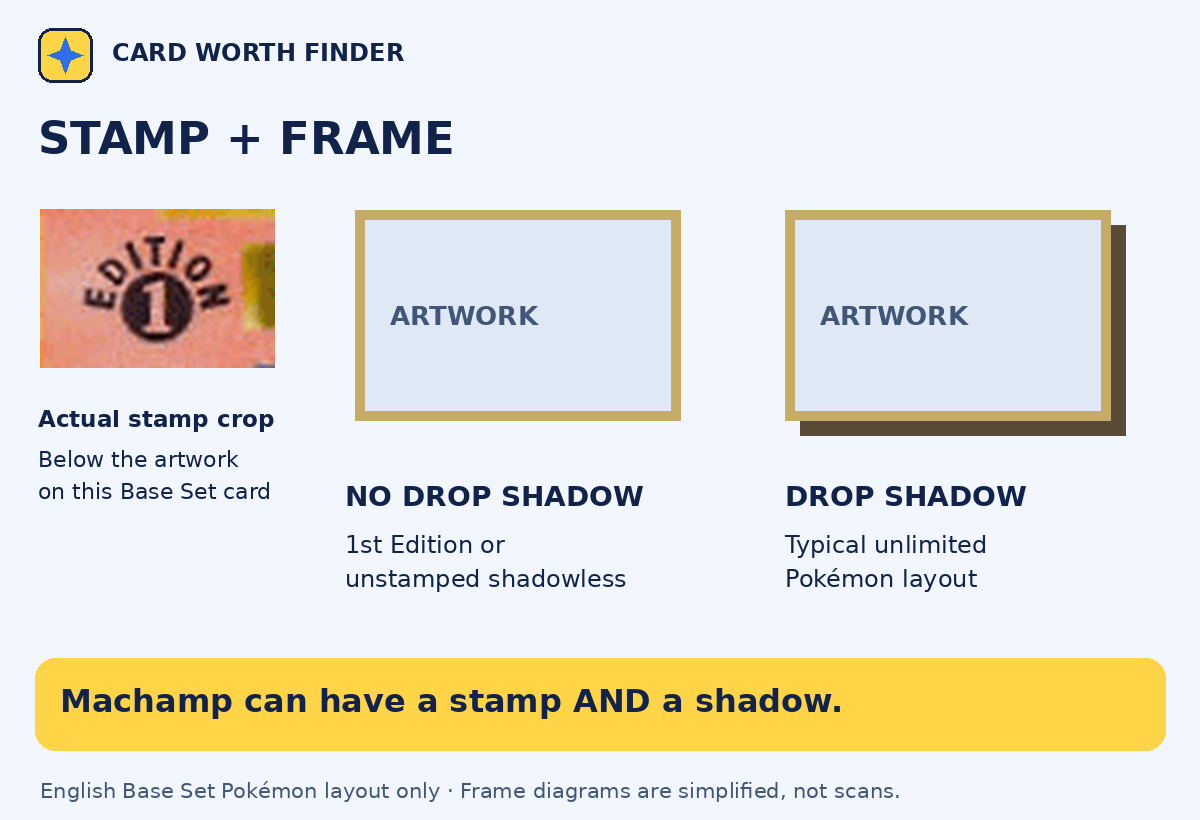
| Printing | Edition stamp | Artwork-frame clue |
|---|---|---|
| 1st Edition | Usually present | No printed drop shadow |
| Shadowless, unstamped | Absent | No printed drop shadow |
| Unlimited | Usually absent | Printed drop shadow beside frame |
The shadow is printed beside the artwork border. Ignore shadows inside the illustration and shadows cast by your room lighting. Compare the same edge in each image, rather than judging the overall darkness of a scan.
Machamp 8/102 is an exception: both shadowless and later shadowed copies can carry an Edition 1 stamp. Trainer and Energy layouts also need different checks. Do not apply this table to every Pokémon set or language. Read the detailed printing guide for those cases.
3. Familiar artwork can belong to a different release
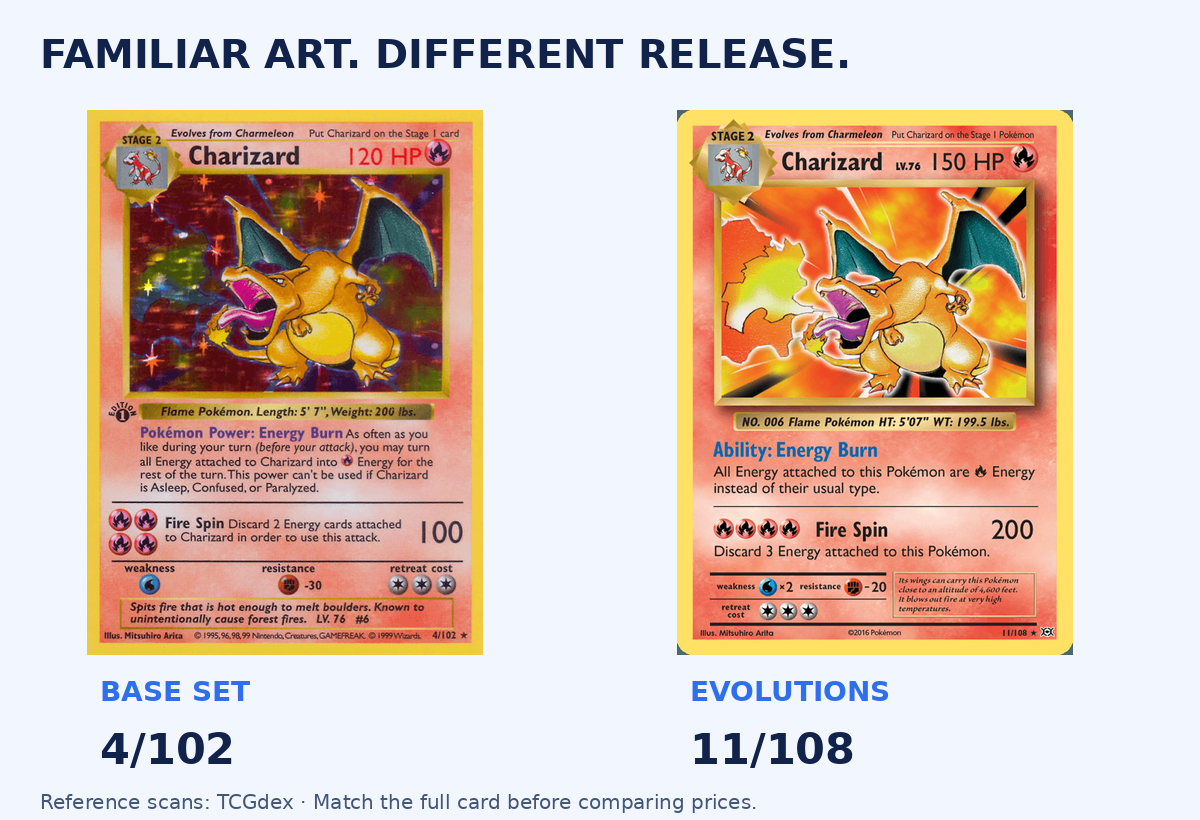
Base Set Charizard is 4/102. The Evolutions version shown here is 11/108 and has different game text and HP. Check the bottom line even when you recognise the picture immediately.
Some reprints keep old numbering. Celebrations Classic Collection, for example, adds the 25th-anniversary Pikachu logo and different foil treatment to familiar cards. A collector number is useful, but it is not a unique identifier across every release. Match the set markings and complete layout too.
If the number matches but the design does not, pause before using the price. Look up the release that actually matches your card. You can start with the Base Set Charizard record or search another card. A provider image represents a card design; it is not an appraisal of every printing.
4. Check language, foil and physical condition
Keep the card language in your notes. For many standard layouts, holofoil appears in the illustration while reverse holo appears outside it; patterns and exceptions vary by set. Tilt your card gently under a light and compare it with a documented example from the same release. A flat scan may not show the finish clearly.
Next, photograph the front and back and note visible scratches, creases, dents and edge wear. A correct design match still does not make two physical copies equivalent. Our condition guide gives a practical inspection routine.
5. Use this five-check lookup note
- Name + full number: copy the card’s printed details.
- Set + language: record the symbol or code and language.
- Printing: note edition stamps and relevant layout clues.
- Finish: confirm the foil variant for that release.
- Condition: record wear and keep clear front/back photos.
Example lookup note: “Charizard · 4/102 · English Base Set · Edition 1 stamp · no frame shadow · holo · condition still to inspect.” This describes the reference image, not a valuation.
Now open Card Worth Finder and locate the matching design. Check the available marketplace’s variant, currency and update date before comparing it with your copy. Missing price data is a reason to research further, not evidence that a card is worthless. See how our displayed prices are selected and what their dates mean.
Quick questions
Does no stamp mean my card is unlimited?
Only after you have identified the relevant set and printing system. Most modern English cards do not use the old first-edition stamp system.
Does this guide tell me whether my card is real?
No. It helps identify a likely design and printing. Matching visible details does not authenticate a physical card. See our authenticity guide for a separate inspection process.
Can I use a graded price for my loose card?
Keep raw cards and specific graded labels separate when comparing sales. Start with the raw-versus-graded guide.
Sources and image credits
- PSA: Pokémon collecting basics — printing, foil and reprint distinctions.
- Relentless Dragon: identifying early Pokémon cards — vintage layout comparisons.
- Relentless Dragon: Base Set Machamp — the stamped shadowed exception. Historical prices in this source are not used here.
- Pokémon: Scarlet & Violet design changes — expansion codes.
- Pokémon: Evolutions Charizard — card identity.
- Pokémon: Celebrations checklist — Classic Collection.
- Base Set first-edition and Evolutions scans: TCGdex. Card artwork © Pokémon / Nintendo / Creatures / GAME FREAK; Charizard illustration by Mitsuhiro Arita. Crops and callouts are for identification. Card Worth Finder is independent.
Keep exploring
Put the checklist to work on your own collection, or open a related guide.